The Performance Equation
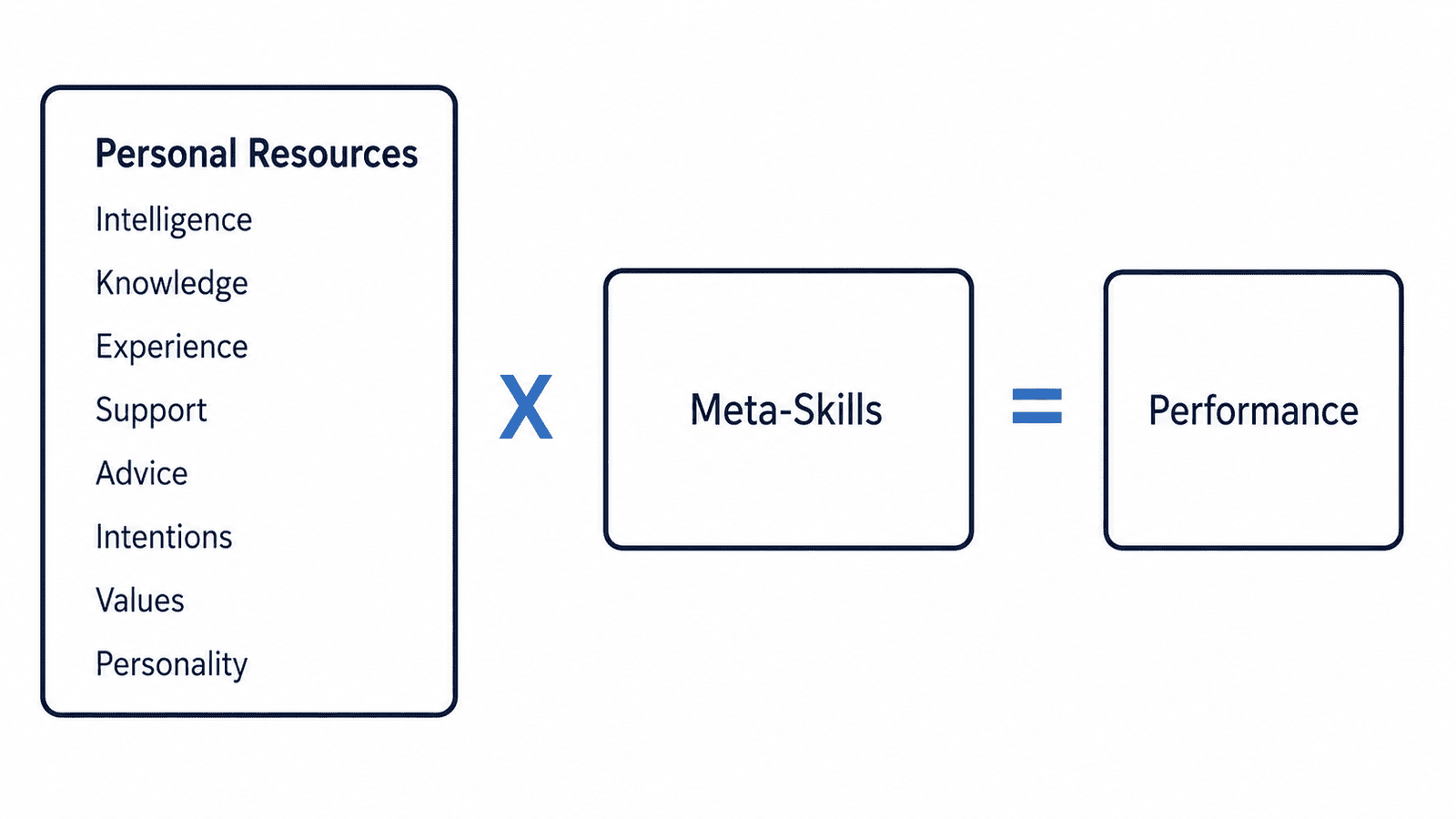
Meta-Skills aren’t “soft skills.” They are an essential part of the underlying infrastructure of performance.
The Executive Environment
Senior leaders operate within overlapping layers of consequence:
- Strategic risk
- Board oversight
- Financial accountability
- Organizational performance
In environments like these, capability alone isn’t enough.
- Cultural stewardship
- Operational efficiency demands
- Stakeholder expectations
- Public and reputational exposure
How We Work
Organizational Impact
- Decisions become clearer and more consistent
- Communication stabilizes
- Friction in execution decreases
- Conflict becomes more manageable
- Trust becomes more predictable
- Greater operational efficiency
- Stronger engagement and retention
- More stable leadership leadership and team productivity
- Improved performance and profitability
Development Pathways
Executives typically engage through one of two pathways.
One-to-One Coaching
12-week program: Optional weekly or bi-weekly sessions
One-to-one executive coaching creates space to look closely at what is happening in your specific situation. Most of the work centers on real moments — conversations, decisions, pressures, and situations that did not go exactly as expected.
We slow those moments down and look carefully at what was shaping them:
- how the situation was being interpreted
- what was happening emotionally
- how that influenced communication and decision-making
- where the interaction, decision, or response began to shift
Over time, this helps you see more clearly what is actually driving outcomes in your environment.
Because the work is confidential, it also allows us to go deeper into areas that may be more sensitive, complex, or difficult to examine in a group setting. This format is often most useful when the situations you are dealing with feel high-stakes, highly visible, politically complex, or personally demanding — or when there are dynamics you would simply prefer to work through privately.
The goal is not to step away from the real work in order to talk about leadership in theory. The goal is to use the real work as the place where development happens.
Cohort Programs
The focus remains on real situations, not theory. But in a cohort format, you are not only learning from your own experience. You are also learning by seeing how other thoughtful people interpret, navigate, and respond to similar challenges.
As you listen to how others think through situations, where they get stuck, what they notice, and how they respond under pressure, your own perspective begins to widen.
You start to see patterns that are harder to recognize when you are focused only on your own situation.
Groups are intentionally kept small so there is enough space for real conversation, meaningful reflection, and direct engagement — while still allowing for the diversity of experience that makes cohort learning so valuable.
Over time, something else often happens. People begin to realize that many of the challenges they are dealing with are not unique to them.
This often reduces some of the pressure people carry, helps normalize the difficulty of real leadership situations, and often makes it easier to think clearly when the next difficult moment arrives.