Effectiveness Doesn't Begin with What You Do
This is where performance actually begins.
- Making a decision that feels clear in the moment—but less certain once you step back
- Responding before you had the full picture—and recognizing it shortly after
- Saying something—and hearing it land harder than you intended
- Moving forward with a decision—even though it doesn’t fully sit right
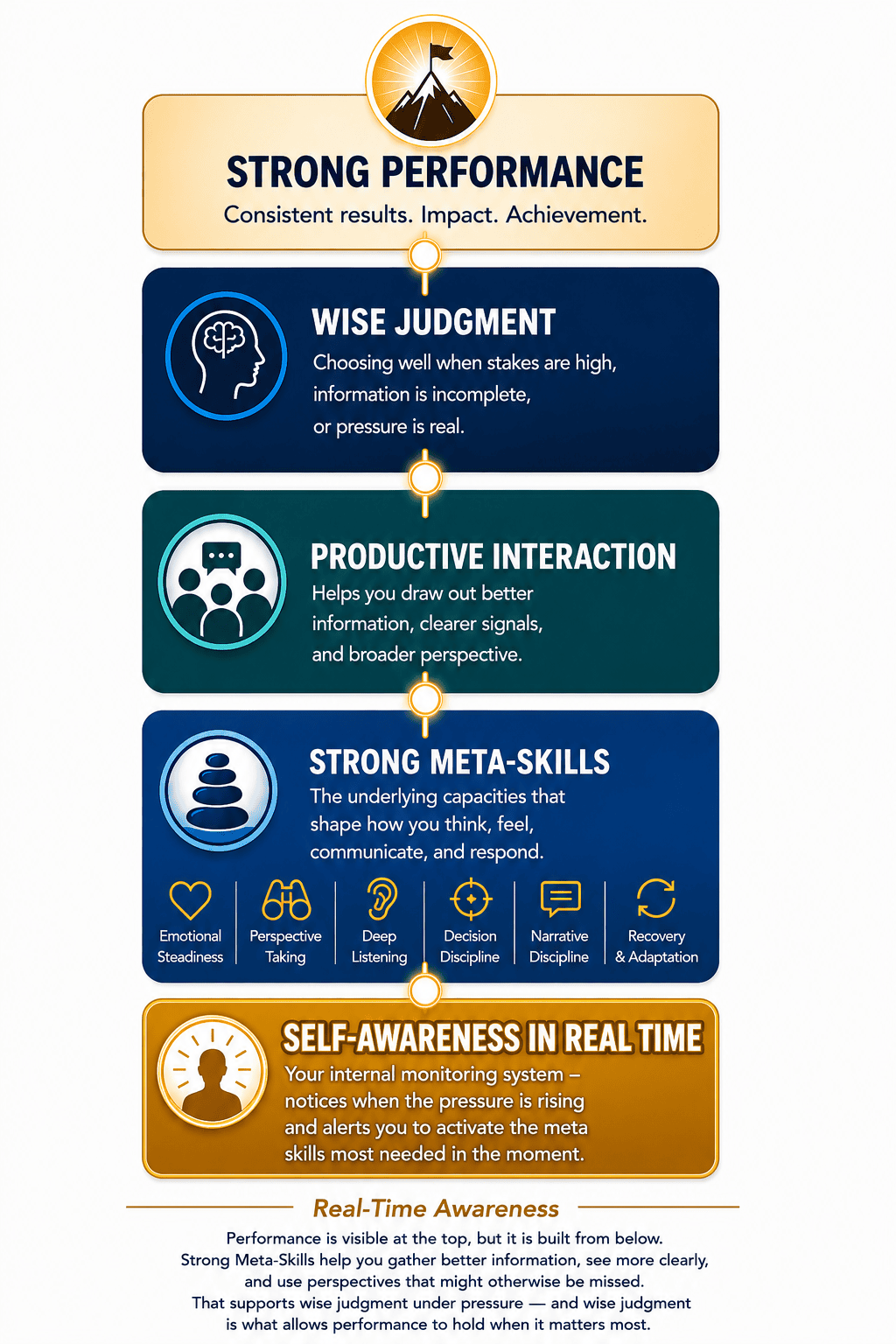
These aren’t knowledge problems. They’re breakdowns in how that knowledge is being used in the moment. Between what you know and how you perform sits a deeper layer of capability—Skills that determine how clearly you think, how steadily you respond, and how effectively you act when it matters most.
The Missing Layer: Meta-Skills
What sits between what you know and how you perform is a set of underlying skills that most people have never been taught to recognize—let alone develop directly.
These are referred to as Meta-Skills.
They regulate how you think, handle emotion, take perspective, and make decisions in real time—especially when pressure is high.
They shape:
• How steadily you regulate emotion when something triggers you
• How clearly you think when situations become complex
• How accurately you interpret what’s happening around you
• How effectively you communicate when conversations become difficult
• How disciplined your decisions remain when stakes are high

META SKILLS CHANGE EVERYTHING
If meta-skills determine how your capability shows up in real time, then small changes at this level have a much larger impact than most people expect.
Because this layer sits upstream of everything else— impacting everything that follows. It influences how you interpret situations, how you regulate emotion, how you communicate, and how you make decisions—before any action is taken.
one shift here doesn’t improve just one outcome—it improves how you perform across many different situations.
You can see this in everyday moments:
The same conversation handled two different ways.
The same decision approached with different levels of clarity.
The same situation leading to completely different outcomes.
Not because the situation changed—but because the internal conditions did. And just as these capacities improve performance when they are strong—they also compound problems when they are not. A small misinterpretation leads to a slightly sharper tone.
That tone creates defensiveness.
The conversation becomes less productive.
The outcome suffers.
Not all at once—but step by step. Most performance problems are not caused by a single mistake. They are the result of small shifts in how we think, feel, and respond—accumulating over time. The same is true in the other direction. When meta-skills strengthen, clarity improves. Conversations become more productive.
Decisions become more consistent.
And performance stabilizes—across situations, not just in isolated moments. This is why improving performance isn’t just about adding new strategies or techniques. It’s about strengthening the capacities that those strategies depend on. And those capacities can be developed—systematically, and over time.
Core Meta-Skills
Emotional Regulation

Perspective-Taking

Decision Discipline

Self-Awareness

Communication

Narrative Discipline
Separating what actually happened from the story you’re telling yourself about it.

Deep Listening

Learning Orientation
Values Clarity
Tolerance for Uncertainty
Judgement and Discernment
Decision Discipline
The Hidden Opportunity: Meta-Skills
Internal capacities that allow clear thinking, emotional regulation, perspective-taking, and constructive response
Strong Meta-Skills
- Communication clarity improves
- Conflict becomes productive
- Decisions are stable
- Trust grows
- Execution accelerates
Weak Meta-Skills
- Communication narrows
- Blame cycles emerge
- Decision-making slows
- Trust erodes
- Execution falters
I Work with People Who?
I work with people who want to think clearly, communicate effectively, and respond better—especially when it matters most.
Senior Executives
Emerging Leaders
Teams
The Meta-Skill Manifesto
Meta-skills shape how people experience themselves, relate to others, and respond to the situations they encounter throughout life. They influence how we behave in groups, how we make decisions when things are uncertain, how we recover from setbacks, and how we approach responsibility, risk, and possibility.
These capacities are always operating—often quietly and largely unnoticed—long before outcomes become visible.
When meta-skills are underdeveloped, people tend to make more errors across a wider range of situations. And because those same underlying capacities also shape how we respond to mistakes, the errors that occur are often handled poorly and the problems they create begin to compound. Over time, that pattern becomes visible across many areas of life — leadership, relationships, and personal growth.
When these capacities are stronger, something different happens. People adapt more easily. They learn more quickly. They respond more effectively to challenges.
Meta-skills shape how people respond when situations become complex, emotionally charged, uncertain, or consequential — across leadership, relationships, families, and everyday life. When these capacities are underdeveloped, difficult situations don’t create failure — they reveal its cause.
When meta-skills strengthen, performance doesn’t improve through pressure or compliance. It improves because the internal interference that disrupts clear thinking, communication, and decision-making begins to diminish. And when that interference diminishes, the intelligence, care, creativity, and commitment — That were already present — are finally able to express themselves more fully.
That’s when goals are not only met.
They’re often exceeded.
Across leadership, relationships, parenting, and personal development, the same truth holds:
Meta-skills determine whether intelligence, capability, and intention actually translate into effective action.
They are the execution layer of human potential.