These underlying capacities are your Meta-Skills.
This pattern has been consistently supported across research in human performance and decision-making for years.

Most people assume performance begins with what you do. In practice, it begins earlier in the underlying capacities that shape
how your abilities are applied in real time.
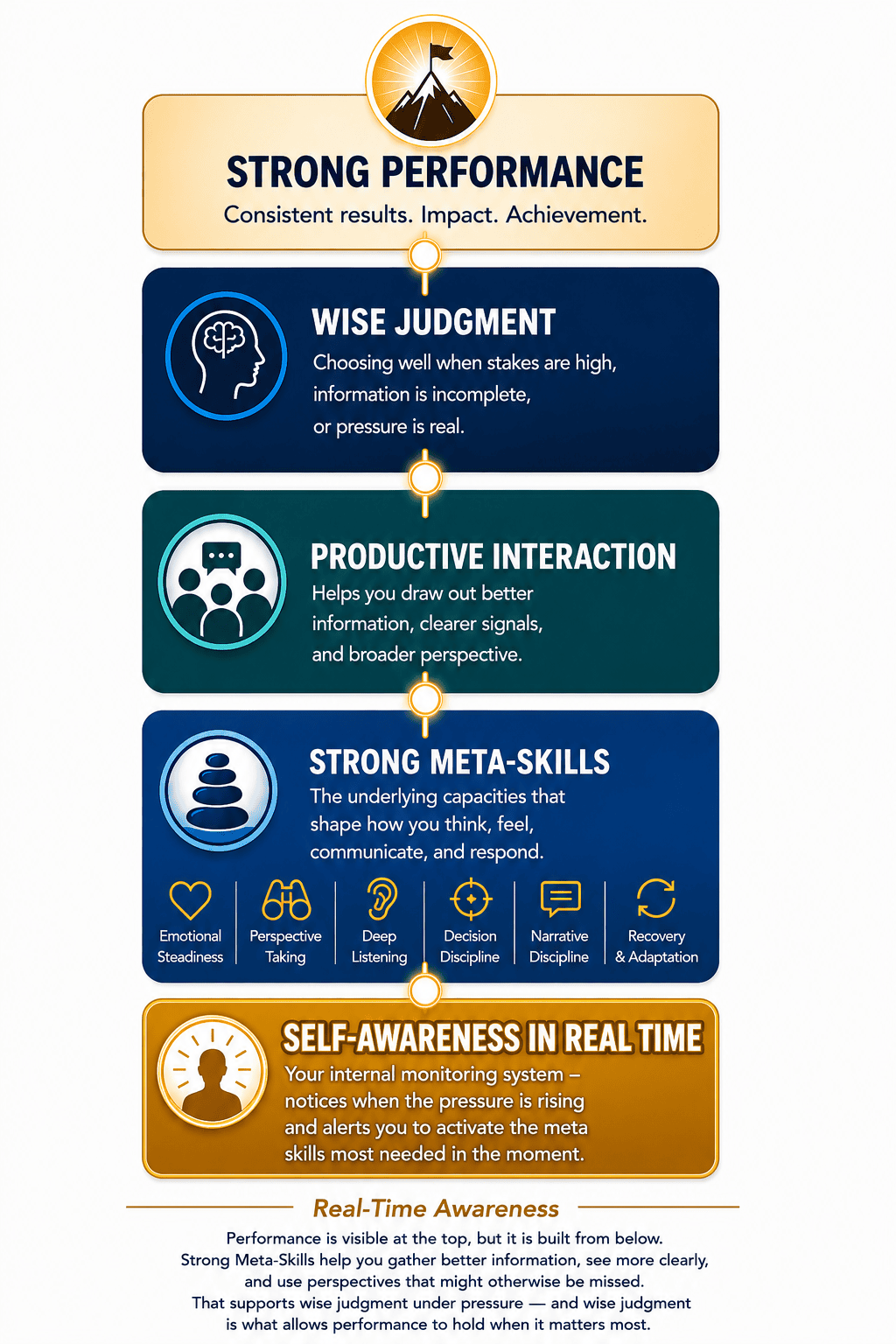
Performance is visible at the top, but it is built from below.
Strong Meta-Skills improve the quality of interaction, which leads to clearer information, broader perspective, and stronger trust.
Those conditions make wise judgment under pressure more likely — and wise judgment is what allows performance to hold when it matters most.
What Are Meta-Skills?
Meta-Skills are the underlying capacities that shape how you interpret what’s happening, how you manage emotion, how you think and respond in real time as events unfold. They influence how clearly you see a situation, how you manage your reactions, and how effectively you communicate especially when situations become more complex, uncertain, or pressured.
Your Meta-Skills are the capacities that determine how effectively
you can use all your other skills.
Core Meta-Skills
Emotional Regulation
Staying steady enough to think clearly and respond intentionally—even when emotions are strong.

Perspective-Taking
Seeing beyond your initial interpretation and considering what else might be true.

Decision Discipline
Making clear, timely decisions without overreacting, avoiding, or second-guessing.

Self-Awareness
The ability to recognize what’s happening within you as it’s happening—and adjust accordingly.

Communication
Saying what needs to be said clearly and effectively—even when the situation is difficult.

Narrative Discipline
Separating what actually happened from the story you’re telling yourself about it.

Deep Listening
Deep Listening is the ability to receive information completely and accurately
before our own reactions begin to distort it.

Learning Orientation
Some people simply repeat the same patterns for years and call it experience.
Learning orientation is the capacity to reflect honestly on experience, so judgment improves over time.
Values Clarity
Values clarity means knowing what should guide you when deciding to stand by a value requires real trade-offs with real costs.
Tolerance for Uncertainty
Most meaningful decisions do not come with perfect clarity. There is usually something missing. Tolerance for uncertainty is the ability to move forward thoughtfully without complete information.
Judgement and Discernment
Judgment is the ability to weigh competing factors and determine what matters most in a particular situation. Discernment is the ability to stay clear enough to see the real issue, not just the most urgent or emotionally loud one.
Decision Discipline
Making clear, timely decisions without overreacting, avoiding, or second-guessing.
These aren’t separate from your skills. They are part of a system that shapes
how your skills show up when it matters most.
My Clients
Senior Executives
Most leaders have a clear sense of what needs to be done.
But as situations become more complex—when pressure builds, stakes rise, and you’re navigating other people’s responses in real time—it becomes harder to stay aligned with that thinking. Reactions happen faster, and how you communicate and make decisions doesn’t always reflect how you want to lead.
This work helps you recognize what’s happening in those moments and respond differently—so you can think clearly, communicate deliberately, and lead effectively when it matters most.
Emerging Leaders
Most people think leadership is about knowing what to do and going in with a plan. But as you step into leadership for the first time—or take on greater
responsibility over time—when expectations rise and you’re navigating other people’s responses, it becomes harder to stay with that plan. Reactions happen faster, consequences carry more weight, and how you communicate and make decisions doesn’t always reflect how you intend to lead. This work helps you recognize what’s happening in those moments and respond differently—so you can think clearly, stay in control of your reactions, and lead consistently when it matters most.
Teams
Most teams have a sense of how they want to operate. But as situations become more challenging—when pressure builds and people are responding in real time—it becomes harder to stay aligned with that approach. Reactions happen faster, and communication and decisions don’t always reflect how the team wants to operate. This work helps teams recognize what’s happening and respond differently—so they can stay aligned, communicate clearly, and operate more effectively when it matters most.

Hi, I'm Andrew!
Over more than 30 years, I’ve worked with a wide range of clients in the corporate and private sectors,
helping them to perform at their best and navigate complex, high-stakes challenges.
In those very different contexts, the same pattern shows up again and again:
performance isn’t determined by skill alone, but by the capacities that shape
how those skills are applied under pressure.
Once you see this, it changes how you understand performance.
That perspective is the focus of my work.